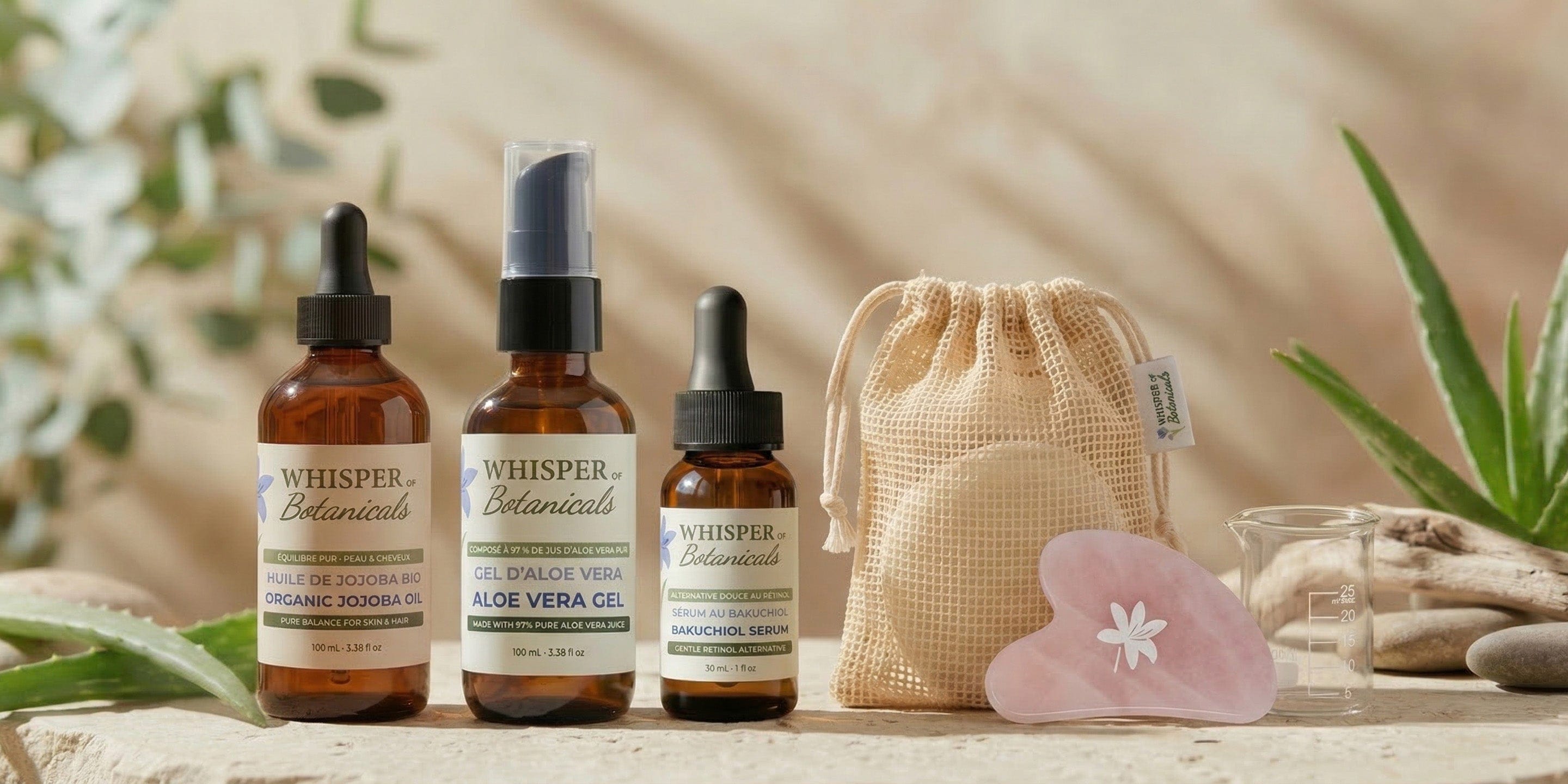

Sculpt, Smooth & De-Puff with Gua Sha
A gentle guide to facial gua sha designed to support lymphatic-style massage, ease facial tension, and leave skin looking fresh and relaxed

What Is It?
A smooth stone tool used to gently massage the face. It glides across the skin to create a calming skincare ritual.

Why Use It?
Often used to support circulation, relax facial tension, and encourage a refreshed-looking complexion.

How Long?
A typical facial routine takes about 3-5 minutes, making it easy to add to your skincare ritual.

How Often?
Use 3–5 times per week, or daily if your skin feels comfortable. Always use light pressure.
Before You Start

Always Use Slip
Apply a facial oil or oil-based serum before beginning. Never glide the tool over dry skin.

Hold at a Low Angle
Keep the tool almost flat against the skin (approximately 10–15°).

Use Light Pressure
More pressure does not mean better results. Gentle, controlled strokes are ideal.

No Back-and-Forth
Glide in one direction, then lift and return to the starting point.

Repeat
3–5 strokes per area is generally sufficient.
Your 8 Steps Ritual

Open the Neck
Use the long edge of the gua sha.
Starting at the collarbone, glide upward along the side of the neck toward the jaw hinge using light pressure.
Lift, return to the starting point, and repeat 3–5 times on each side.

Forehead
Use the long edge of the gua sha.
Starting above the brow, glide upward toward the hairline using gentle pressure.
Lift, return to the starting point, and repeat 3–5 times per area.

Brow Bone
Use the V edge of the gua sha.
Starting at the inner brow, glide outward along the brow bone toward the temple using light pressure.
Lift, return to the starting point, and repeat 3–5 times.

Under-Eye
Use the small curve of the gua sha.
Starting at the inner corner, glide outward toward the temple using very light pressure.
Lift, return to the starting point, and repeat 3–5 times.

Upper Cheek
Use the V edge of the gua sha.
Starting beside the nose, glide outward across the upper cheek using light pressure.
Lift, return to the starting point, and repeat 3–5 times.

Lower Cheek
Use the long edge of the gua sha.
Starting at the mid-cheek, glide outward toward the ear using light to gentle pressure.
Lift, return to the starting point, and repeat 3–5 times.

Jawline
Use the V edge of the gua sha.
Starting at the center of the chin, glide along the jawline toward the ear using light to gentle pressure.
Lift, return to the starting point, and repeat 3–5 times.

Finish with the Neck
Use the long edge of the gua sha.
Starting below the ear, glide down the side of the neck toward the collarbone using light pressure.
Lift, return to the starting point, and repeat 3–5 times on each side.
🌿 Everything You Want to Know About Gua Sha
🌿 Everything You Want to Know About Gua Sha
🧭 The Origins of Gua Sha
🧭 The Origins of Gua Sha
Gua sha has roots in traditional Chinese wellness practices, where it has historically been used on the body to support circulation and overall wellness.
Traditional gua sha techniques often involve firmer pressure and are performed on the body rather than the face.
Modern facial gua sha is a much gentler adaptation of this technique, designed specifically for delicate facial skin and relaxation-focused skincare rituals.
Today, facial gua sha is widely used in holistic skincare routines around the world.
🪨 What Is a Gua Sha Tool?
🪨 What Is a Gua Sha Tool?
A gua sha tool is a smooth, flat massage tool designed to glide across the skin. Facial gua sha tools are typically made from polished stones or crystals such as rose quartz, jade, or stainless steel.
These tools feature curved edges and angles that allow them to follow the natural structure of the face, including the jawline, cheekbones, brow bone, and neck.
Unlike rollers, which roll over the skin, gua sha tools are designed to sweep along the skin using controlled strokes, allowing for more targeted massage and sculpting movements.
Most facial gua sha tools are small, ergonomic, and shaped to provide several working edges for different areas of the face.
✨ Rose Quartz in Lithotherapy
✨ Rose Quartz in Lithotherapy
In holistic wellness traditions, rose quartz has long been associated with calm, balance, and self-care rituals.
Within lithotherapy (the practice of using stones and crystals in wellness traditions), rose quartz is often connected with qualities such as emotional comfort, relaxation, and gentle energy. Because of its soft pink color and symbolic associations with compassion and care, it is frequently referred to as the “stone of love.”
While these meanings come from cultural and spiritual traditions rather than scientific research, many people enjoy incorporating natural stones like rose quartz into their skincare rituals as part of a mindful self-care practice.
Using a gua sha tool made from rose quartz can therefore combine:
- a facial massage technique
- the tactile feel of natural stone
- a calming moment of personal care
For many people, this adds an extra layer of intention and relaxation to their skincare routine.
💧 Understanding Lymphatic Drainage in Facial Massage
💧 Understanding Lymphatic Drainage in Facial Massage
The lymphatic system is a network of tiny vessels and nodes that helps move excess fluid, waste, and cellular by-products away from tissues and back toward the bloodstream.
Unlike the circulatory system, the lymphatic system does not have a pump like the heart. Instead, lymph fluid moves slowly through the body with the help of muscle movement, breathing, and gentle external stimulation.
This is where facial massage techniques like gua sha can play a role.
When performed with light pressure and slow strokes, gua sha movements can help encourage the natural movement of lymphatic fluid along the face and neck toward lymph nodes located near the ears, jaw, and collarbone.
Because of this, facial massage is often associated with helping the skin appear:
- less puffy
- more refreshed
- more sculpted
- temporarily more defined
It is important to note that facial gua sha supports the natural movement of fluid rather than “draining” it in a medical sense.
For this reason, gentle pressure and slow movements are key. Applying too much pressure can compress tissues and reduce the relaxing, supportive effect of the massage.
Most facial gua sha routines begin with strokes along the neck and collarbone, which helps encourage fluid movement toward the larger lymphatic pathways in the body.
🌬️ Why Gua Sha Movements Are Usually Upward and Outward?
🌬️ Why Gua Sha Movements Are Usually Upward and Outward?
Facial gua sha strokes typically move upward and outward across the face.
This direction helps:
- follow natural facial muscle structure
- support lymphatic pathways toward the ears and neck
- create lifting and sculpting massage movements
For the neck, strokes often move upward toward the jaw, then gently guide fluid downward toward the collarbone where larger lymphatic drainage pathways are located.
Each stroke should be performed in one direction, lifting the tool between passes rather than moving it back and forth.
🛠️ How Gua Sha Tools Are Made?
🛠️ How Gua Sha Tools Are Made?
Facial gua sha tools are traditionally made from stone or crystal that has been carefully shaped and polished to create smooth, gliding edges.
The process generally involves:
- Cutting the raw material into slabs
- Shaping the tool into its final silhouette
- Polishing the edges and surfaces until smooth
- Inspecting the finished piece for consistency and comfort
Because natural stone varies in color, translucency, and pattern, each genuine gua sha tool tends to have a slightly unique appearance.
Rose quartz is one of the most popular materials used for facial gua sha tools because of its smooth feel, durability, and soft pink tone.
Today, many gua sha tools on the market are also made from resin, glass, or synthetic materials designed to imitate natural stone. Some are marketed as jade or rose quartz even when they are not genuine stone.
While these imitation tools may look similar, they often do not have the same weight, feel, natural coolness, or material quality as authentic stone gua sha tools. Poorly made tools may also have less refined edges or surface finishing, which can make the glide feel less comfortable on the skin.
For facial massage, a well-made tool with a smooth finish and comfortable shape matters more than appearance alone.
🤍 Why Gua Sha Is Loved in Skincare?
🤍 Why Gua Sha Is Loved in Skincare?
Facial gua sha has become popular in modern skincare because it combines massage, relaxation, and skincare application into a simple ritual.
Many people enjoy gua sha because it can help:
- Encourage healthy-looking circulation
- Support natural lymphatic drainage
- Relax facial tension and tight muscles
- Enhance the application of facial oils and serums
- Create a calming, mindful self-care moment
When practiced regularly with gentle pressure, gua sha can help the skin appear refreshed and energized.
The ritual itself can also be deeply relaxing, making it a favorite addition to evening skincare routines.
🧴 How Gua Sha Works With Skincare Products?
🧴 How Gua Sha Works With Skincare Products?
Gua sha tools are most commonly used with facial oils or oil-based serums. These products create the slip needed for the tool to glide smoothly across the skin.
Without proper slip, the tool may drag on the skin and create unnecessary friction.
Many people pair gua sha with:
- Facial oils
- Oil-based serums
- Rich moisturizers
- Overnight treatments
Using gua sha after applying your skincare products can also help distribute them more evenly across the skin.
🌿 Typical Uses of Gua Sha in Skincare Routines
🌿 Typical Uses of Gua Sha in Skincare Routines
Facial gua sha is commonly incorporated into skincare routines to gently massage different areas of the face and neck.
Popular areas include:
- Neck and lymphatic drainage pathways
- Jawline and chin
- Cheeks and cheekbones
- Brow bone and forehead
- Under-eye area (with very light pressure)
Many people perform a short gua sha ritual lasting 3–10 minutes, either in the morning to help refresh the face or in the evening as part of a relaxing skincare routine.
❓ How Often Should You Use Gua Sha?
❓ How Often Should You Use Gua Sha?
Facial gua sha can be performed several times per week, or even daily if done gently.
Many people prefer using gua sha:
- in the morning to help refresh the face
- in the evening as part of a relaxing skincare routine
Consistency is often more important than duration. A short, gentle ritual practiced regularly can help maintain the relaxing and revitalizing effects of facial massage.
🫧 Skin Compatibility & Sensitivity
🫧 Skin Compatibility & Sensitivity
Facial gua sha is generally suitable for most skin types when practiced gently and with proper slip.
However, it is best to avoid using gua sha directly over:
- Active acne breakouts
- Inflamed or irritated skin
- Broken skin or open wounds
- Severe rosacea flare-ups
Using excessive pressure is not necessary and can lead to redness or irritation. Gentle, controlled strokes are typically the most effective.
If you have very sensitive skin or a specific skin condition, consider consulting a skincare professional before incorporating facial massage tools into your routine.
🧼 Cleaning & Care
🧼 Cleaning & Care
Keeping your gua sha tool clean helps maintain good skincare hygiene.
After each use:
- Wash the tool with warm water and a gentle soap
- Rinse thoroughly
- Dry with a clean towel
Avoid harsh chemical cleaners or abrasive scrubbing.
Many people also enjoy storing their gua sha tool in the refrigerator to create a naturally cooling sensation during use.
⏳ Durability & Storage
⏳ Durability & Storage
Gua sha tools made from stone or crystal are durable but should still be handled with care.
To extend the life of your tool:
- Store it in a protective pouch or container
- Avoid dropping it on hard surfaces
- Clean it regularly after use
With proper care, a gua sha tool can last for many years.
⚠️ Common Gua Sha Mistakes to Avoid
⚠️ Common Gua Sha Mistakes to Avoid
Facial gua sha is a simple practice, but using the correct technique can make the experience much more comfortable and effective. Many beginners make small mistakes that can reduce the benefits of the massage.
Here are some of the most common things to avoid.
Using Gua Sha on Dry Skin
One of the most common mistakes is using a gua sha tool without enough slip.
The tool should glide smoothly across the skin, not drag or pull. Applying a facial oil or oil-based serum before starting helps create the slip needed for comfortable, gentle strokes.
Without proper slip, the tool can create friction that may irritate the skin.
Applying Too Much Pressure
More pressure does not mean better results.
Facial gua sha works best with light to moderate pressure and slow, controlled strokes. Excessive pressure can cause redness, discomfort, or irritation.
The goal is to gently glide the tool across the skin rather than pressing deeply into the tissues.
Moving the Tool Back and Forth
Gua sha strokes should generally move in one direction.
After completing a stroke, lift the tool and return to the starting point rather than dragging it back and forth across the skin. This helps maintain controlled movements and reduces unnecessary friction.
Holding the Tool at a Steep Angle
The gua sha tool should be held almost flat against the skin.
Most facialists recommend an angle of roughly 10–15 degrees so that the smooth edge of the tool glides comfortably along the face. Holding the tool too upright can create pressure points and reduce the smoothness of the massage.
Skipping the Neck
Many people focus only on the face and forget the neck.
Beginning with gentle strokes along the neck and collarbone can help prepare the lymphatic pathways before working on the face. This is why many facial gua sha routines start by opening the neck area.
Using Gua Sha Over Irritated Skin
It is best to avoid using gua sha directly over:
- active acne breakouts
- inflamed or irritated skin
- broken skin
- severe rosacea flare-ups
Allow the skin to recover before performing facial massage in those areas.
Rushing the Ritual
Facial gua sha is meant to be slow and mindful.
Moving too quickly can reduce the relaxing nature of the massage and make it harder to maintain gentle pressure and proper technique. Even 3–5 minutes of slow strokes can be enough to enjoy the ritual.
🛡️ Safety Information
🛡️ Safety Information
- For external use only
- Use with a facial oil, serum, or moisturizer for proper slip
- Use light pressure only
- Do not use on dry, broken, irritated, or inflamed skin
- Avoid contact with eyes
- Clean after each use
- Discontinue use if irritation occurs
- Keep out of reach of children


Sculpt. Glow. Restore.
An ancient beauty ritual, thoughtfully reimagined for modern self-care.
Our Rose Quartz Gua Sha is carved from authentic stone and shaped to follow the natural contours of the face and neck.
When used consistently, it helps support circulation, soften the look of puffiness, and encourage a visibly refreshed glow.
Cool to the touch and naturally weighty in the hand, it transforms a simple skincare routine into a grounding daily ritual.
Used with a facial oil or serum, it glides smoothly across the skin - supporting product absorption and inviting a moment of quiet presence.
This natural stone tool is a long-term ritual piece, designed to last for years with proper care.
A timeless tool for sculpted, luminous-looking skin.
Important
Important
Specs & Materials
Specs & Materials
Care Instructions
Care Instructions
In stock
SKU:GUASHA-V1